
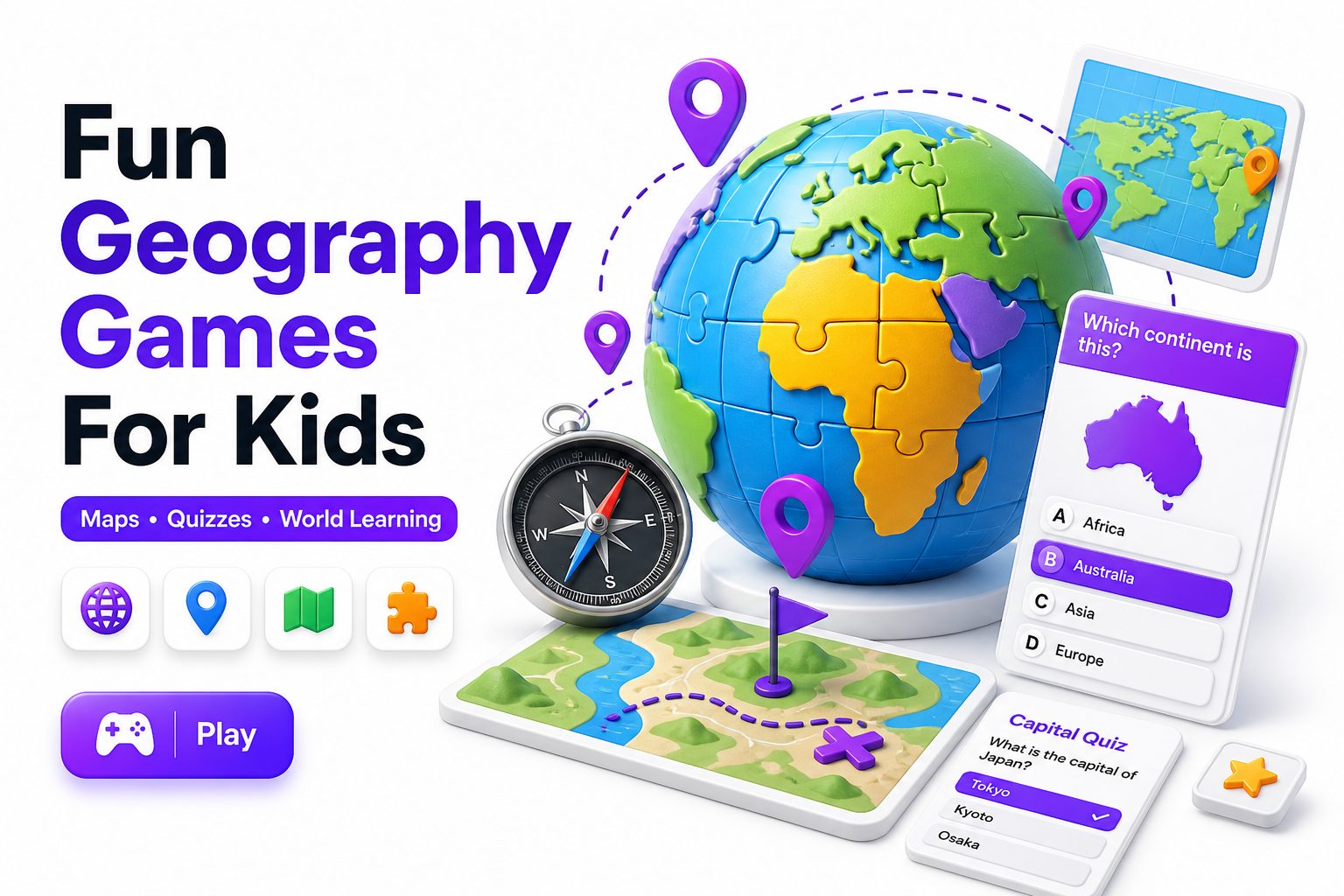
Geography can feel like a list of places until children get to touch it, race across it, guess it, build it, or connect it to real life. That is why parents and teachers often ask, what are some fun geography games for kids that actually hold their attention and help them remember what they learn.
The best geography games do more than drill capitals or point to countries on a map. They build curiosity about landforms, cultures, directions, climates, landmarks, travel, and how places connect. A child who plays “guess the country” at the dinner table may later notice a news story, recipe, animal habitat, or sports event from that same region.
A strong geography game can be simple, noisy, quiet, printable, digital, competitive, or cooperative. The key is choosing activities that match a child’s age and making the world feel close enough to care about.
Map Treasure Hunts for Active Learning
Map treasure hunts are one of the easiest ways to turn geography into movement. Give children a simple map of a room, yard, classroom, park, or neighborhood, then ask them to follow directions, identify symbols, and locate hidden objects using north, south, east, and west.
For younger children, keep the map visual and use familiar landmarks like a sofa, tree, bookshelf, or playground slide. Older children can handle coordinates, grid references, compass clues, scale, and route planning. This helps them see maps as useful tools, not just school worksheets.
Country Guessing Games with Clues
Country guessing games work well because they combine facts, memory, and deduction. One player gives clues about a country’s continent, language, food, climate, flag colors, famous landmarks, or neighboring countries. The other players guess with as few clues as possible.
To make it fair, start broad and get more specific. For example, “This country is in South America,” then “It has the Andes,” then “Its capital is Lima.” Children learn location, culture, and physical geography while practicing careful listening and reasoning.
Quick Game Ideas for the First Week
Try a mix of easy, fast geography games before choosing favorites. Short activities reduce pressure and help children build confidence.
Map a bedroom, classroom, or backyard.
Guess a country from three clues.
Match flags to countries or continents.
Name places starting with each letter of the alphabet.
Trace a route between two cities on a map.
Play a five-minute capital city challenge.
Find countries mentioned in books, movies, or sports.
Build a paper passport and stamp it after each activity.
Flag Matching and Memory Games
Flag games are colorful, visual, and surprisingly good for pattern recognition. Children can match flags to countries, sort flags by color, spot repeated symbols, or play a memory-card version with country names on one card and flags on another.
Avoid turning flag learning into pure memorization at first. Ask what children notice: stars, stripes, suns, animals, shields, crosses, crescents, or color patterns. These details can lead naturally into conversations about history, identity, regions, and how countries represent themselves.
World Map Floor Games
A large floor map, shower-curtain map, printed poster, or taped outline can make geography feel physical. Children can stand on continents, jump to oceans, place toys on countries, or move along routes as if they are traveling across the world.
This approach is especially helpful for younger kids who learn through movement. Ask them to “fly” from Brazil to Japan, “sail” across the Atlantic Ocean, or “walk” from Canada to Mexico. Spatial learning becomes easier when their bodies are involved.
Globe Spin Challenges
A globe spin challenge is quick, flexible, and fun for homes or classrooms. Spin the globe, stop it with one finger, then name the nearest country, ocean, continent, or major city. Add questions based on the child’s level.
You can turn each spin into a mini research task. Children might find the country’s capital, draw the flag, name an animal that lives there, or compare its climate with their own region. A simple globe becomes a doorway into global awareness.
Capital City Relay
A capital city relay adds speed and teamwork to geography practice. Put country cards on one side of the room and capital cards on the other. Children race to match pairs correctly, either one at a time or in small teams.
For beginners, use a small set such as five countries from one continent. For older children, include state capitals, world capitals, or bonus cards with rivers, mountains, and landmarks. The relay format makes repetition feel energetic instead of repetitive.
Tips for Choosing Age-Appropriate Geography Games
Good geography games should stretch children without frustrating them. A seven-year-old may enjoy continents and flags, while a twelve-year-old may be ready for time zones, coordinates, population, and regional comparisons.
Start with familiar places before moving outward.
Use visuals for younger children.
Keep timed rounds short.
Mix physical games with quiet map work.
Let children choose countries that interest them.
Add cultural facts, food, music, or animals.
Avoid correcting every mistake immediately.
Return to the same places over several days.
Geography Bingo with Landmarks
Geography bingo works well for groups because everyone can play at once. Create bingo cards with landmarks such as the Eiffel Tower, Grand Canyon, Great Wall of China, Pyramids of Giza, Mount Fuji, and Sydney Opera House.
Instead of calling the landmark name, give a clue. Say, “This ancient structure is in Egypt,” or “This mountain is a symbol of Japan.” Children mark the answer if they have it. The game builds recognition while linking landmarks to countries and regions.
Continent Sorting Games
Continent sorting is a strong early geography activity. Give children cards with animals, foods, countries, landmarks, climates, or famous natural features. Their task is to place each card under the correct continent and explain their choice.
Some cards will create useful discussion because geography is not always neat. Penguins may point toward Antarctica, but they also live in parts of South America and other southern regions. These moments help children see geography as real and layered.
Map Puzzle Races
Map puzzles are excellent for visual memory and shape recognition. Children can assemble a country, continent, world map, or state map puzzle while naming places as they fit each piece into position. The physical act supports long-term recall.
Turn puzzle time into a race only when children are comfortable with the map. Some kids enjoy speed, while others need time to study shapes and borders. Cooperative puzzle building can work better for mixed ages or children who dislike competition.
Key Benefits of Geography Games for Kids
Geography games support far more than map knowledge. They build flexible thinking, pattern recognition, cultural awareness, and practical navigation skills.
Stronger memory for countries, states, and capitals.
Better awareness of cultures and world regions.
Improved map reading and direction skills.
More interest in travel, history, science, and current events.
Practice with teamwork and communication.
Stronger visual and spatial reasoning.
More confidence using atlases, globes, and digital maps.
A natural way to connect school topics with daily life.
Neighborhood Mapping Adventures
Children do not need to start with the whole world. A neighborhood mapping adventure teaches the same basic skills using places they already know. Ask them to draw a route from home to school, a park, library, grocery store, or friend’s house.
Add map features like symbols, labels, a compass rose, and a simple legend. Older children can estimate distance, compare routes, or mark safe crossings. This activity helps geography feel practical and gives children language for describing real spaces.
Latitude and Longitude Battleship
Latitude and longitude can feel abstract until children use them in a game. Create a grid map and hide “ships,” landmarks, or treasures at coordinates. Players call out coordinates, then mark hits and misses just like a classic guessing game.
Once they understand the grid, move to real maps. Ask children to find approximate coordinates for cities, islands, mountains, or national parks. The game turns a difficult concept into something concrete and gives older kids useful map-reading confidence.
Weather and Climate Matchups
Weather and climate games help children connect geography with daily life. Give them place cards and climate clues, then ask them to match deserts, rainforests, tundra regions, mountains, islands, and coastal areas with likely weather patterns.
For example, children can compare Arizona, Iceland, Brazil, and Indonesia. Ask what clothing they would pack, what animals might live there, and what homes might need in that climate. These practical questions make climate zones easier to remember.
Practical Materials to Keep Nearby
A small geography game kit makes spontaneous learning easier. Keep supplies simple so games can happen at the table, outside, or during a short break.
World map or atlas.
Globe or inflatable globe.
Blank map printouts.
Sticky notes or index cards.
Colored pencils or markers.
Timer or stopwatch.
Compass if available.
Flag cards.
Small toys or tokens.
Notebook for country facts.
Online Map Quiz Games
Online map quizzes are useful when children like immediate feedback. Games that ask kids to click countries, states, capitals, rivers, or oceans can strengthen recall through repeated practice. They work especially well in short, focused sessions.
Choose quizzes by region and difficulty. A child learning continents should not start with every country in Europe or Africa. Start with broad map skills, then narrow the focus. For extra support, pair online practice with a physical map nearby.
National Geographic Kids Style Quizzes
Kids often enjoy geography more when it is connected to animals, photos, habitats, and real-world stories. Quiz formats inspired by National Geographic Kids can combine maps with wildlife, landmarks, environments, and culture in a more vivid way.
A parent or teacher can create a simple version at home. Show a picture of a rainforest animal, famous building, desert landscape, or traditional food, then ask children to identify the region or country. Images make place-based learning more memorable.
Google Earth Scavenger Hunts
Google Earth scavenger hunts can make geography feel immediate. Ask children to find their home city, a famous stadium, a volcano, a desert, a rainforest, or a landmark they have heard about. They can zoom, rotate, and compare places visually.
Set clear goals before opening the tool so the activity stays focused. A hunt might include finding three islands, two mountain ranges, one capital city, and one river delta. Digital maps become richer when children search with purpose.
Checklist for Safe and Productive Digital Play
Digital geography games can be valuable, but they work best with structure. Use short sessions and keep the focus on learning rather than endless clicking.
Choose age-appropriate websites or apps.
Preview games before children use them.
Set a clear time limit.
Avoid games overloaded with ads.
Use full-screen mode when possible.
Pair digital play with a paper map.
Ask children to explain one thing they learned.
Rotate online games with hands-on activities.
Board Games That Teach Geography
Board games can teach geography through routes, countries, resources, landmarks, and strategy. Look for games where the map matters, not just games with a world map printed in the background. The best options encourage place recognition and decision-making.
Ticket to Ride, Trekking the World, and similar map-based games can help children think about routes and regions. For younger kids, simplified travel games or homemade map boards often work better than complex strategy games with long rulebooks.
Homemade Travel Passport Game
A homemade passport game gives children a reason to collect facts. Create a booklet with pages for country names, flags, foods, landmarks, animals, and one fun fact. Each time they complete a geography activity, they earn a stamp or sticker.
This game works especially well across several weeks. Children can “visit” one country per day or one continent per month. Add books, recipes, music, or short videos to make each destination feel distinct and connected to real people.
Food Map Challenge
Food is one of the most natural ways to teach geography because it connects place with culture, climate, agriculture, and trade. Choose a food such as rice, chocolate, pasta, corn, bananas, or spices, then trace where it grows or became popular.
Children can place recipe cards on a map and compare meals from different regions. Keep the activity respectful by avoiding stereotypes and using accurate country names. This helps children see geography as connected to families, farms, markets, and traditions.
Important Facts About Teaching Geography Through Play
Children remember geography better when facts are connected to action, images, and stories. Games help create those connections naturally.
Maps teach distance, direction, and location.
Flags can introduce national identity and history.
Landmarks connect geography with culture.
Climate games link place with science.
Food activities show how geography affects daily life.
Movement games help younger learners stay engaged.
Short repetition is more effective than long drilling.
Choice increases curiosity and motivation.
Geography Charades
Geography charades adds humor and movement to place-based learning. Children act out a country, landform, animal habitat, weather pattern, or landmark while others guess. A child might pretend to climb a mountain, paddle a river, or shiver in the Arctic.
Use cards to keep the game moving. Include volcano, island, desert, rainforest, bridge, canyon, glacier, waterfall, and capital city. After each round, ask one follow-up question so the game includes learning without slowing down the fun too much.
Landform Building Games
Landform building games are ideal for hands-on learners. Use clay, sand, blocks, paper, or recycled materials to build mountains, valleys, rivers, islands, peninsulas, bays, lakes, plains, and volcanoes. Children learn vocabulary by shaping what the words mean.
After building, ask children to label each landform and explain how water, weather, or people might interact with it. They can add roads, towns, farms, or forests. This connects physical geography with human geography in a simple, concrete way.
State and Country Alphabet Race
An alphabet race is simple, fast, and adaptable. Players try to name a state, country, city, river, or landmark for each letter of the alphabet. You can play aloud, on paper, or as a team challenge on a whiteboard.
For younger children, allow atlases and maps. For older children, add rules such as “only countries,” “only cities outside your country,” or “one place per continent.” This game strengthens recall and exposes gaps without making children feel tested.
Tips for Making Geography Games More Engaging
Small changes can make geography games more memorable. The goal is to keep curiosity alive while still building accurate knowledge.
Use real maps, not only worksheets.
Connect places to animals, food, music, or sports.
Let children pick countries they want to study.
Repeat favorite games with new regions.
Use teams for mixed-age groups.
Keep score lightly.
Celebrate good reasoning, not only correct answers.
Ask children to teach a round themselves.
Mystery Postcard Game
The mystery postcard game asks children to solve a place using clues. Write a short postcard from an imaginary traveler. Include details about weather, nearby landmarks, language, food, animals, or landforms without naming the location.
Children use maps and reasoning to guess the destination. For example, a postcard mentioning gondolas, canals, and Italy points to Venice. A clue about geysers, glaciers, and Reykjavik points to Iceland. This game blends reading comprehension with geographic thinking.
Route Planning Challenges
Route planning helps children think like travelers. Give them a start and end point, then ask them to plan the route using maps. They might choose the fastest path, safest path, most scenic route, or a route that crosses certain landforms.
Older children can compare transportation options such as walking, driving, flying, or taking a train. Add budgets, time limits, or climate conditions for a bigger challenge. This teaches geography as decision-making, not just memorizing where places are.
Time Zone Games
Time zones are tricky but fascinating for children. Start with simple examples: when it is morning at home, what time might it be in London, Tokyo, or Los Angeles. Use clocks, maps, and real-world situations like calling a friend abroad.
Turn it into a scheduling game. Children must plan a video call, sports broadcast, or birthday message across different countries. This shows why longitude, rotation, and global time matter in daily life. It also builds practical global awareness.
Classroom Geography Team Games
Team games help children learn from one another. Divide the class into small groups and give each team a map challenge, country clue set, or landmark puzzle. Teams earn points for correct answers and clear explanations.
For better learning, rotate roles within each team. One child reads clues, one checks the map, one records answers, and one explains the reasoning. This keeps stronger students from doing all the work and gives quieter students a clear job.
Solo Geography Games for Quiet Practice
Not every child wants loud group games. Solo activities such as map puzzles, online quizzes, country fact cards, coloring maps, and passport journals give children time to think. These options work well for homework, independent study, or calm classroom stations.
Solo games also make progress visible. Children can track countries learned, flags recognized, or maps completed over time. A simple chart helps them see growth without turning geography into a stressful subject. Quiet practice often builds strong confidence.
Family Geography Games for Dinner or Travel
Family geography games do not need many materials. During dinner, ask everyone to name a country connected to the meal, a place in the news, or a city they would like to visit. Keep rounds short and conversational.
Car rides are also useful for geography. Children can read road signs, spot license plates, follow the route on a map app, or compare towns along the way. Everyday travel becomes a chance to practice direction, distance, regions, and place names.
Simple Rules for Better Geography Game Nights
A few clear rules make geography games smoother and more useful for children of different ages.
Keep rounds under ten minutes.
Use hints before giving answers.
Allow maps for beginners.
Mix easy and challenging questions.
Let children create clues.
Avoid making speed the only goal.
Connect each game to one clear skill.
End while children still want another round.
How to Adapt Geography Games for Different Ages
Preschool and early elementary children usually benefit from big shapes, colors, songs, movement, and simple location words. Focus on home, neighborhood, land and water, continents, oceans, animals, and flags with bold patterns.
Upper elementary and middle school students can handle more detail. Add capitals, coordinates, regions, physical features, population, trade, migration, time zones, and current events. If you need more activity ideas by grade level, use [Internal Link: geography activities for kids] as a natural next step.
Common Mistakes to Avoid
One common mistake is starting too hard. Asking children to memorize every country or capital before they understand continents can make geography feel discouraging. Build from familiar to unfamiliar, and let maps stay visible during early practice.
Another mistake is treating geography as isolated facts. Places become meaningful when connected to people, food, weather, animals, history, sports, stories, and travel. For related classroom ideas, see [Internal Link: map skills for elementary students] to connect games with broader learning goals.
How to Keep Geography Games Fresh
Rotate formats so children are not always doing the same kind of recall. Use movement one day, drawing the next, digital quizzes later, and discussion-based clues after that. Variety helps children practice the same ideas from different angles.
You can also theme games around seasons, holidays, sports events, books, or family plans. A winter theme might focus on polar regions and mountains. A soccer theme might focus on countries in a tournament. Personal relevance keeps geography from feeling distant.
Conclusion
Geography becomes much easier for children to enjoy when it is playful, active, and connected to real life. Maps, flags, puzzles, clues, food, landmarks, digital tools, and travel challenges all help children build a stronger sense of place without relying only on memorization.
The best approach is to mix formats. Use a floor map when children need movement, a globe when they need visual context, a quiz when they need practice, and a story-based clue game when they need curiosity. Keep sessions short, repeat favorite activities, and let children ask their own questions about the world.
If you have been wondering what are some fun geography games for kids, the answer is that the most effective ones are simple, flexible, and easy to connect with everyday life. Start with one map, one set of clues, or one country, then build from there.
FAQ
What age should kids start playing geography games?
Children can start simple geography games around ages four or five. Begin with home, neighborhood, land, water, continents, and animals. Add countries, capitals, coordinates, and time zones as their reading and reasoning skills grow.
Are online geography games good for kids?
Online geography games can be helpful when they are age-appropriate, focused, and used in short sessions. They give quick feedback and support repetition, but they work best when paired with paper maps, globes, and discussion.
How can I teach geography without making it boring?
Use movement, clues, puzzles, food, flags, photos, and real maps. Children learn better when places connect to something memorable, such as animals, sports, family travel, weather, stories, landmarks, or meals from different regions.
What is the easiest geography game for beginners?
A globe spin game is one of the easiest options. Spin the globe, stop it with a finger, and identify the nearest continent, ocean, or country. Add simple facts as children become more confident.
How often should kids practice geography?
Short practice two or three times a week works well for most children. Ten minutes of focused play is usually more useful than a long memorization session. Repetition over time helps maps and place names stick.
0 Comments