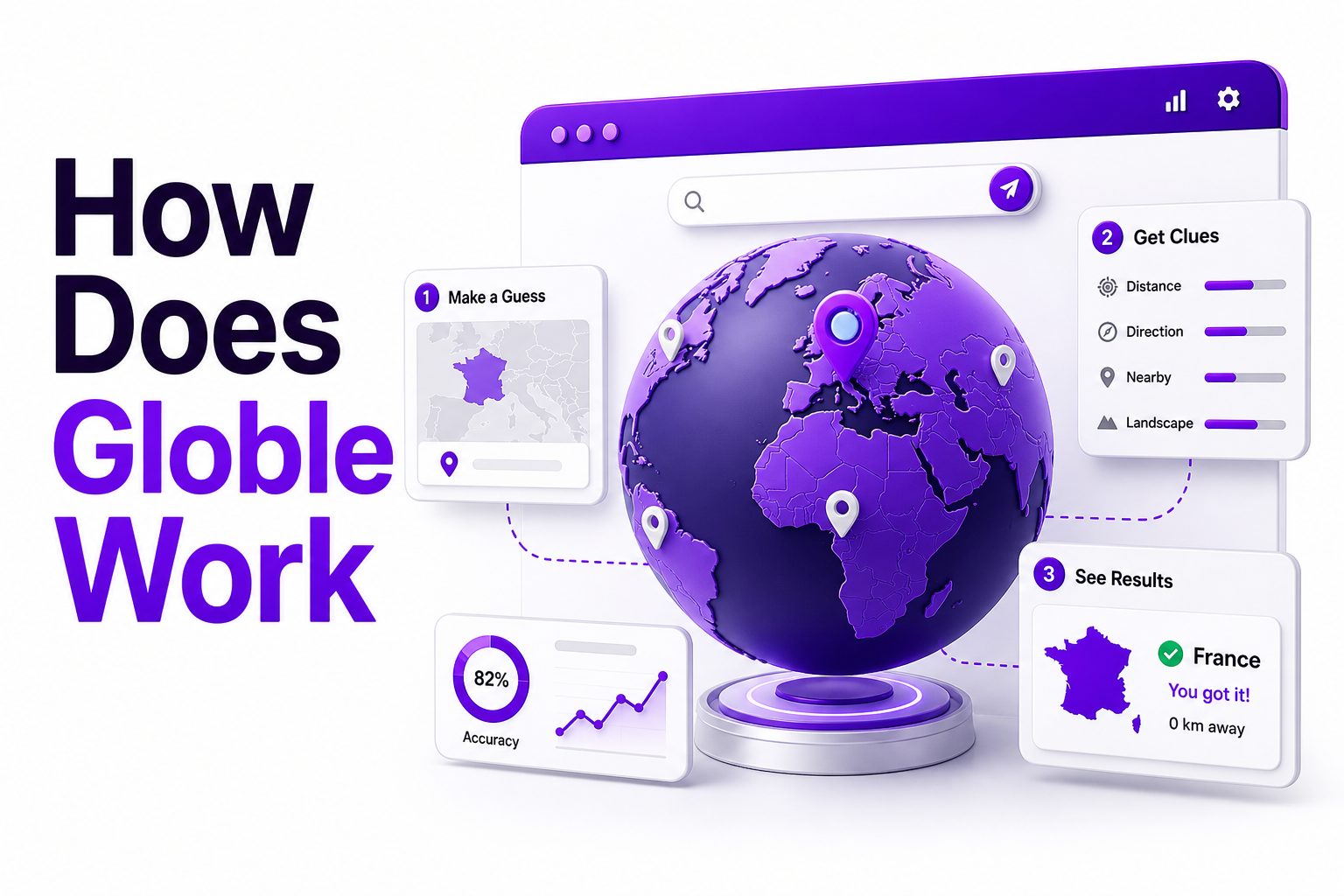
Globle looks simple at first: type a country, check the color, and keep guessing until you find the hidden answer. But once you start playing, the puzzle becomes more than a geography quiz. It tests how well you read distance clues, connect regions, and narrow down possibilities across the world map.
If you have searched for how does Globle work, you probably want more than a basic rule summary. You want to know why some guesses turn red, why others stay pale, and how skilled players use each attempt to move closer to the answer. This guide breaks down the game in practical terms, from the color system to smarter guessing habits, so you can play with more confidence and less random clicking.
What Globle Is
Globle is a daily geography guessing game where the goal is to identify a mystery country. Each guess appears on a globe, and the game uses color to show how close your guess is to the correct answer. The closer the country, the warmer the color becomes.
Unlike word games that rely on letters, Globle uses real-world location knowledge. You are not checking spelling patterns or word positions. You are reading geographic distance, regional context, and borders to work out where the hidden country is likely to be.
The Basic Goal of Globle
The main objective is to find the secret country in as few guesses as possible. You can guess almost any recognized country, and the globe reacts by shading that country according to its distance from the target. Every guess gives you a clue.
A pale guess means you are far away, while a darker red guess means you are getting close. The game does not tell you direction directly, so you need to compare several guesses to build a mental map of where the answer could be.
Quick Globle Facts
- Globle is usually played as a daily puzzle.
- The answer is a country or territory recognized by the game.
- Colors show distance from the mystery country.
- Warmer colors mean closer guesses.
- The game does not give letter clues.
- You can use unlimited guesses in most versions.
- Geography knowledge helps, but logic matters just as much.
How the Color System Works
The color system is the heart of Globle. After each guess, the selected country is shaded on the globe. A very light color means the guess is far from the answer, while deeper shades of orange and red mean the answer is geographically nearby.
This is why how does Globle work is often tied to color interpretation. The game is not saying your guess shares language, culture, continent, or borders. It is mainly showing physical distance, so nearby countries usually become much darker than distant ones.
Why Distance Matters More Than Borders
Many players assume a shared border is always the key clue, but Globle is based on proximity rather than border logic alone. A country across a narrow sea may be closer than a land neighbor of another region, depending on geography.
For example, guessing Greece might point you toward Turkey, Albania, or Bulgaria, but it could also suggest nearby island countries or eastern Mediterranean locations. The best players look at the whole surrounding area instead of only checking countries with direct land borders.
Reading Warm and Cold Guesses
A cold guess gives useful information even when it feels wrong. If Canada appears very pale, you can usually move away from North America. If Egypt appears warmer, you may start checking North Africa, the Middle East, or nearby Mediterranean countries.
Warm guesses need careful interpretation. A dark red result tells you that you are near the answer, but not always in the exact same region. You still need to test surrounding countries to identify whether the target lies north, south, east, or west.
Color Clue Comparison
Color Clue What It Usually Means Best Next Move
Very pale Very far from the answer Guess a different continent
Light orange Somewhat closer Test nearby regions
Orange-red Fairly close Try neighboring countries
Dark red Very close Check borders and nearby islands
Deep red Almost there Guess immediate neighbors
How to Make Your First Guess
A strong first guess should give you broad geographic information. Many players start with a large, central, or strategically placed country such as Turkey, Egypt, Brazil, India, or France. These countries help divide the world into useful regions.
Your first guess does not need to be perfect. Its job is to create a reference point. Once you know whether that country is warm or cold, your second guess should test a different direction rather than repeat the same general area blindly.
Smart Opening Countries
Good opening countries often sit near multiple regions. Turkey touches Europe and Asia, Egypt connects Africa and the Middle East, and India helps test South Asia quickly. These guesses cover more strategic ground than isolated countries at the edge of the map.
Large countries can be helpful, but they are not always better. Russia, Canada, and China cover huge areas, yet their size can make distance clues less precise. A smaller but centrally located country can sometimes give cleaner information early in the puzzle.
Narrowing Down the Region
Once you have two or three guesses, compare their colors instead of judging each one separately. If Turkey is warm and France is cooler, the answer may be east or southeast of Europe. If Brazil is warm and Mexico is cold, South America becomes more likely.
This comparative approach is what separates guessing from solving. Globle rewards players who treat each clue as part of a pattern. Your goal is to triangulate the answer by testing different points and watching which countries become warmer.
Opening Guess Tips
- Start with a country near several regions.
- Avoid guessing tiny islands too early unless you have a reason.
- Use your second guess to test a different direction.
- Compare colors across guesses before committing.
- Move gradually from continent-level guesses to border-level guesses.
- Keep mental notes of which areas are clearly cold.
- Do not chase one warm country without checking nearby alternatives.
How Globle Handles Countries and Territories
Globle usually accepts countries and some territories, depending on the version you are playing. This can occasionally surprise players, especially when the answer is a small island, remote territory, or politically complex location not used in everyday geography quizzes.
Because accepted answers may vary, it helps to pay attention to the autocomplete list. If the game suggests a name, it is likely valid. When a country you expect does not appear, try an alternate official name or a related territory name.
Why Small Countries Can Be Tricky
Small countries are hard because they are easy to overlook on the globe. Places such as Liechtenstein, San Marino, Nauru, or Saint Kitts and Nevis may be close to a warm guess but visually difficult to spot without zooming or rotating carefully.
Island nations add another layer of difficulty. A warm coastal guess might point toward a nearby island rather than another mainland country. This is common in the Caribbean, Pacific, Mediterranean, and Indian Ocean, where many countries are close but separated by water.
Using the Globe View Effectively
Rotating the globe matters more than many beginners realize. A country may look distant on a flat map but appear closer on a globe, especially near polar routes or across oceans. The game’s globe format reminds players that distance is three-dimensional.
Zooming can also help with small targets. When your guesses become very warm, slow down and inspect the surrounding area. Look for microstates, islands, enclaves, and neighboring countries that may not be obvious at the default zoom level.
Common Difficult Country Types
Country Type Why It Is Difficult Example Approach
Microstates Easy to miss visually Check small European states near warm guesses
Island nations Not always near mainland Scan surrounding seas and island chains
Landlocked states Hidden between larger ones Check borders carefully
Remote countries Few nearby references Use ocean-region knowledge
Territories Naming may vary Use autocomplete suggestions
How Globle Differs From Wordle
Globle was clearly inspired by daily puzzle culture, but it plays very differently from Wordle. Wordle gives exact letter feedback, while Globle gives spatial feedback. You are not eliminating letters; you are eliminating geographic areas.
This changes the way strategy works. A weak Wordle guess might waste valuable letter positions, but a weak Globle guess can still reveal a whole continent is unlikely. Even wrong answers can be useful if they help you rule out large parts of the map.
Why Globle Feels More Open-Ended
Globle gives players unlimited room to reason. There is no fixed grid and no six-guess limit in many versions, so the pressure comes from self-improvement rather than failure. You can play casually or challenge yourself to solve in fewer attempts.
This open format also makes the game more educational. Every puzzle can teach you where countries are in relation to one another. Over time, you start remembering regional clusters, island chains, and countries you rarely see in standard geography lessons.
How Search Intent Fits the Game
People searching how does Globle work usually need help with mechanics, not just the definition. They want to know how colors translate into useful action. The most important lesson is that each country guess is a distance marker.
Once you understand that, the game becomes more logical. You are looking for the point where several clues overlap. The hidden country is usually near the warmest guess, but the true answer often appears only after you test nearby alternatives.
Globle Versus Similar Puzzle Games
Feature Globle Wordle Worldle
Main clue type Distance color Letter position Country outline
Subject Geography Words Geography
Guess limit Often unlimited Usually six Usually limited
Main skill Spatial reasoning Vocabulary logic Shape recognition
Best strategy Regional narrowing Letter elimination Map knowledge
How to Build a Better Guessing Strategy
A good Globle strategy starts wide and gets narrow. Begin with countries that divide the globe into broad zones, then move toward warmer areas. Once you find a hot region, switch from continent-level thinking to nearby-country thinking.
Do not guess every country around a warm clue in random order. Test direction first. If Spain is warm, try Morocco, France, Italy, or Algeria depending on what earlier clues suggest. Each guess should answer a specific location question.
Using Triangulation in Globle
Triangulation means using multiple guesses to estimate where the answer sits between them. If Egypt is warm, Turkey is warmer, and Iran is cooler, the target may be somewhere in the eastern Mediterranean or nearby western Asia.
You do not need math to triangulate well. You simply compare relative warmth. The correct answer often sits near the warmest guess but away from colder nearby guesses. This habit makes your guesses more deliberate and reduces wasted attempts.
Avoiding Guess Spirals
A guess spiral happens when you keep guessing countries near one warm clue without checking the broader region. For example, if Kenya is warm, you might guess Tanzania, Uganda, Ethiopia, Rwanda, and Somalia without testing whether the answer is farther toward the Arabian Peninsula.
To avoid this, pause after two or three close guesses. Ask what direction has not been tested. A single well-placed guess outside the cluster can reveal whether you are circling the answer or moving away from it.
Practical Strategy Checklist
- Start with one broad reference country.
- Choose a second guess from a different region.
- Compare warmth rather than reacting to one clue.
- Move toward the warmest area slowly.
- Test north, south, east, and west when close.
- Remember islands and microstates.
- Use autocomplete to confirm valid names.
- Zoom in when colors become very warm.
Common Mistakes New Players Make
The most common beginner mistake is treating the warmest country as the answer’s direct neighbor. Sometimes that is true, but not always. Distance can point across water, around borders, or toward a small country hidden between larger ones.
Another mistake is guessing only famous countries. Globle includes many places that players may not immediately remember. If your guesses keep getting hotter but obvious neighbors are wrong, think smaller. The answer may be a less familiar country nearby.
Ignoring Oceans and Island Chains
Oceans are not empty space in Globle. They often separate countries that are still geographically close. A warm guess in Venezuela might point toward Caribbean islands, while a warm guess in Indonesia could point across many nearby island nations.
Island chains are especially important in the Pacific and Caribbean. Countries can be small, scattered, and hard to see. When a coastal country is hot but mainland neighbors fail, rotate and zoom around the surrounding sea.
Overvaluing Continents
Continents are useful early, but they can mislead later. Countries near continental edges often sit close to places officially considered part of another continent. Turkey, Egypt, Russia, Panama, and Indonesia are good examples of locations that complicate simple continent thinking.
Instead of relying only on continent labels, think in regions. The Caucasus, Balkans, Levant, Caribbean, Sahel, Central Asia, and Pacific Islands are often more useful categories. Regional thinking gives you better precision as the puzzle tightens.
Beginner Mistakes to Avoid
Mistake Why It Hurts
Guessing only large countries Misses small nearby answers
Ignoring islands Leaves many valid answers unseen
Following one warm clue blindly Wastes guesses in one direction
Thinking only by continent Misses cross-border regions
Skipping map inspection Makes small countries harder to find
How to Use Geography Knowledge Without Memorizing Everything
You do not need to memorize every country to enjoy Globle. Basic regional awareness is enough to improve quickly. Knowing which countries sit in West Africa, Central America, Southeast Asia, or the Balkans will help you interpret clues faster.
When you miss a puzzle, treat it as a quick geography lesson. Look at the countries around the answer and note which guesses helped most. Over time, repeated exposure builds a stronger mental map without formal study.
Learning Regional Clusters
Regional clusters are groups of nearby countries that often appear together in Globle reasoning. Examples include the Baltic states, the Gulf countries, the Andean countries, and the island nations of Oceania. Recognizing these clusters helps you guess efficiently.
For a deeper geography practice routine, you could pair Globle with [Internal Link: country map quiz tips]. Daily puzzles become more useful when you review the surrounding region after each answer instead of moving on immediately.
Using Maps After the Puzzle
Looking at a map after solving is one of the best ways to improve. Check which countries were closest, which ones were misleading, and whether water distance affected your assumptions. This turns each puzzle into practical map training.
If you track your guesses, you may notice patterns. You might struggle with Central Asia, mix up West African countries, or forget small Caribbean nations. Those weak spots are easy to fix once you can name them.
Regions Worth Practicing
- Balkans: many small countries close together.
- Caucasus: compact area between Europe and Asia.
- Caribbean: island nations with tricky spacing.
- Pacific Islands: remote countries spread across huge distances.
- West Africa: many borders and similarly placed countries.
- Central Asia: large landlocked countries that are often confused.
- Middle East: compact region with strong distance clues.
How Daily Globle Puzzles Are Usually Solved
Most successful solves follow a simple pattern. Players begin with a broad guess, shift toward the warmer part of the world, then test neighboring countries until the answer becomes obvious. The process feels faster once you trust the clues.
For example, if your first guess is India and it appears cold, you might test Brazil or France. If France is warm, you can move into Europe, North Africa, or the Mediterranean. Each new country sharpens the search area.
A Sample Solve Pattern
Imagine guessing Egypt first and seeing a medium-warm color. You then guess Turkey, which becomes darker. That suggests the answer may be around the eastern Mediterranean, Balkans, Caucasus, or Middle East rather than deep Africa.
Next, you guess Greece and it is very warm. Now the likely area is tight. You might check Albania, North Macedonia, Bulgaria, Cyprus, or nearby island countries. A few targeted guesses should lead you to the answer.
When the Answer Is Far From Your Expectations
Sometimes Globle feels surprising because the correct country is closer than it appears in your mental map. Globe distance can challenge flat-map assumptions, especially near Russia, Alaska, Greenland, the Arctic, and island regions.
When this happens, do not assume the game is wrong. Rotate the globe and check the actual spatial relationship. You may find that two places are much closer across water or polar areas than they seem on common classroom maps.
Daily Solving Routine
Step Action
One Make a broad regional guess
Two Test another part of the world
Three Move toward the warmer clue
Four Compare nearby countries
Five Check small states and islands
Six Use zoom when the search area tightens
Seven Review the answer region after solving
Tips for Solving Globle in Fewer Guesses
If you care about lowering your guess count, choose opening guesses with purpose. A random country can still help, but a strategic country gives better information. Many experienced players start with countries that sit near major regional crossroads.
After the first clue, resist the urge to guess too close too soon. If the first guess is only slightly warm, jump far enough to test another area. Early guesses should separate continents and regions, not chase tiny differences.
Memorize High-Value Neighbor Groups
Some neighbor groups come up often because they are dense and confusing. The Balkans, Central America, the Gulf, and West Africa all contain many countries in a compact space. Learning these areas can reduce your guess count quickly.
You do not need perfect memorization. Just knowing the order of nearby countries helps. If Serbia is hot, you should immediately think of Bosnia and Herzegovina, Montenegro, Kosovo, North Macedonia, Albania, Croatia, Hungary, Romania, and Bulgaria.
Keep a Personal Weak-Spot List
A simple note of missed countries can speed up improvement. If you often miss island nations, write down the ones that appear. If you confuse countries in Africa, group them by region and review them occasionally.
This works better than memorizing a full atlas at once. Globle improvement comes from repeated pattern recognition. A short, personal list based on your own mistakes is more useful than a huge list you never revisit.
Fewer-Guess Tips
- Use broad opening guesses with regional value.
- Compare at least two clues before narrowing hard.
- Learn compact regions with many countries.
- Check islands when coastal guesses are warm.
- Use smaller countries once the area is clear.
- Keep a short list of missed answers.
- Practice with maps, not only names.
Why Globle Is Useful for Learning Geography
Globle teaches geography through feedback. Instead of studying a static map, you interact with country locations and immediately see whether your assumptions are accurate. That active process makes the information easier to remember.
It also helps players notice relationships they may have missed. You start to see how close North Africa is to southern Europe, how island chains connect regions, and how large countries can distort distance expectations.
A Better Way to Remember Countries
Memory improves when information is tied to a problem. If you miss Laos after guessing Thailand, Vietnam, and Cambodia, you are more likely to remember where Laos sits next time. The mistake becomes a useful anchor.
This is why Globle can be more effective than passive map browsing. Each puzzle gives you a reason to care about the answer. That small challenge makes the geography feel practical rather than abstract.
Using Globle With Other Geography Tools
Globle pairs well with quizzes, blank maps, and region-based practice. If you want a stronger foundation, use [Internal Link: world geography learning games] alongside your daily puzzle routine. The combination builds both recall and spatial awareness.
For best results, focus on one weak region at a time. If you struggle with Oceania, spend a few minutes reviewing Pacific island countries. Then your next Globle puzzle in that area will feel less random.
Learning Benefits
Benefit How Globle Helps
Spatial memory Shows country distance visually
Regional awareness Reinforces nearby country groups
Map confidence Encourages globe rotation and inspection
Long-term recall Connects mistakes to useful feedback
Problem solving Builds logical guessing habits
Conclusion
Globle is simple to start, but the real skill comes from reading distance clues well. Each guess tells you how close a country is to the hidden answer, and the colors help you narrow the world from broad regions to specific neighbors. Strong players compare clues, test directions, remember small countries, and stay alert to islands and cross-water distance.
The best way to improve is to play slowly enough to learn from each attempt. Start with useful reference countries, move toward warmer areas, and zoom in when the puzzle gets close. Over time, you will build a stronger mental map and recognize regional patterns faster. If you came here wondering how does Globle work, the key takeaway is straightforward: it is a geography puzzle built around proximity, logic, and patient elimination.
FAQ
How do Globle colors show the answer?
Globle colors show how close each guessed country is to the mystery country. Pale colors mean far away, while darker red shades mean closer. The color does not reveal direction, so comparing several guesses is important.
Is Globle based on borders or distance?
Globle is mainly based on geographic distance. A neighboring country is often close, but countries across narrow seas can also be very near. Players should think about actual location, not only shared land borders.
Can Globle answers be small countries?
Yes, Globle answers can include small countries, and some versions may include territories. Microstates and island nations are easy to miss, so zooming in and checking autocomplete suggestions can help during close guesses.
What is a good first guess in Globle?
A good first guess is usually a central country near several regions, such as Turkey, Egypt, India, France, or Brazil. The goal is not to solve immediately, but to create a useful distance reference.
How can I get better at Globle?
Compare colors across guesses, practice regional country groups, and review the answer area after each puzzle. Focus especially on islands, microstates, and regions where many countries sit close together.
0 Comments