
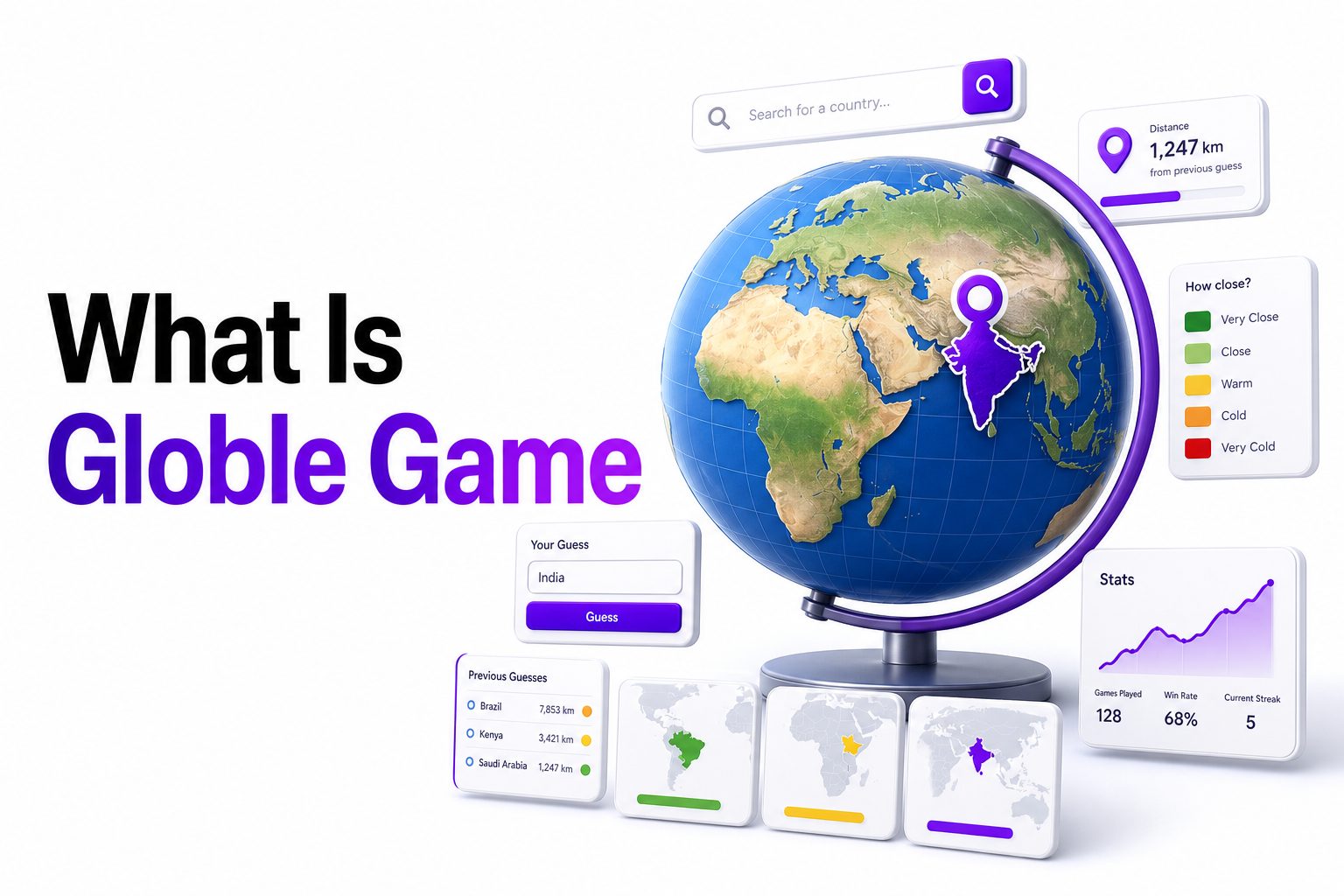
If you enjoy daily word games but want something with a sharper geography twist, Globle is one of the most satisfying browser games to try. Many players search for what is Globle game after seeing colored country guesses shared online or hearing friends talk about solving the daily mystery country. The idea is simple: guess a country, read the color feedback, and narrow your way toward the correct answer.
Unlike trivia quizzes that reward memorized facts alone, Globle rewards spatial thinking. You are not asked to spell a hidden word or answer multiple-choice questions. Instead, you use a world map, distance clues, regional knowledge, and careful elimination. Each wrong guess still teaches you something useful, which is why the game feels fair even when the answer is difficult.
Globle has become popular because it is quick, challenging, and easy to replay as a daily habit. It suits casual players, geography students, map lovers, travelers, and anyone who likes puzzles built around deduction.
What Globle Game Means
Globle is a daily geography guessing game where the goal is to identify a mystery country using map-based clues. After each guess, the country you selected appears in a color shade that shows how close your guess is to the hidden answer.
The warmer the color, the closer your guessed country is to the correct country. A pale or cool shade means you are far away, while a deeper red tone means you are getting close. This simple visual system makes the puzzle easy to follow.
How Globle Became Popular
Globle grew during the wider rise of daily puzzle games that can be played in a few minutes. Players liked that it offered a familiar daily format while focusing on geography instead of words, numbers, or trivia categories.
Its appeal also comes from how shareable it is. Players can compare how many guesses they needed without spoiling the answer. That makes it easy to discuss with friends, classmates, or online communities while keeping the daily challenge intact.
Key Facts About Globle
- Globle is a daily country guessing game.
- The answer changes once per day.
- Each guess gives color-based distance feedback.
- Warmer colors mean closer guesses.
- The game is usually played in a browser.
- It rewards geography knowledge and logical deduction.
- There is no strict guess limit in the standard format.
- It is different from Wordle because it uses countries, not words.
How the Globle Game Works
The game begins with a blank or neutral globe and a search box where you enter a country name. Once you submit a guess, that country is highlighted on the globe. Its color tells you how near or far it is from the target country.
Your task is to use each guess as a clue. If France appears very light, the answer is probably not in Western Europe. If Turkey turns orange or red, you may focus on nearby countries such as Georgia, Armenia, Syria, Bulgaria, or Iran.
Reading the Color Clues
Color is the main feedback system in Globle. A country that appears in a deeper red shade is geographically closer to the answer. A country with a lighter shade is farther away, giving you a broad sense of direction.
The game does not simply tell you north, south, east, or west. You must interpret distance through the globe itself. This makes the puzzle more rewarding because every guess asks you to think about real-world location, borders, and regional proximity.
Why Players Like Globle
Globle feels educational without behaving like a school quiz. You learn country locations naturally through repeated play, especially when you start noticing which countries are close to one another across regions and continents.
It also gives players a strong sense of progress. Even a bad first guess is useful because it removes part of the map from consideration. With each turn, the possible answer zone becomes smaller and the puzzle becomes more focused.
Globle Compared With Similar Games
Game Type | Main Skill | Daily Format | Feedback Style
Globle | Geography deduction | Yes | Country color warmth
Wordle | Vocabulary and spelling | Yes | Letter color tiles
Worldle | Country shape recognition | Yes | Distance and direction
GeoGuessr | Location observation | Varies | Visual map clues
Flagle | Flag knowledge | Yes | Flag reveal clues
Globle stands out because it combines map awareness with deduction. You do not need to identify street signs, flags, or country outlines. You need to judge distance and refine your guesses based on location.
Rules of Globle Game
The main rule is simple: guess the mystery country using as few guesses as possible. You enter valid country names, study the color feedback, and continue until you find the correct answer. The puzzle resets with a new country each day.
Most versions do not punish you for guessing too many times, but many players still track their score. A lower guess count feels more satisfying, especially when the answer is in a region with many small neighboring countries.
What Counts as a Valid Guess
A valid guess is usually a recognized country name accepted by the game’s search system. Some names may need official spellings or common English versions, so players may have to choose from suggested results as they type.
Dependent territories, disputed regions, or alternative names may not always work. If a name does not appear in the search box, try the country’s standard English name. This keeps the game focused and avoids confusion during daily play.
Best Starting Guesses
A strong starting guess gives useful information across a wide area. Many experienced players begin with a centrally located country or a country near the middle of several regions, such as Turkey, Egypt, India, France, or Brazil.
There is no perfect first guess every day. The best choice depends on how you like to play. Some players use the same opener for consistency, while others rotate openers across continents to make the game feel less predictable.
Smart Starting Guess Ideas
- Turkey for Europe, the Middle East, Central Asia, and North Africa.
- Egypt for Africa, the Middle East, and the Mediterranean.
- India for South Asia, Southeast Asia, and Central Asia.
- France for Western Europe, North Africa, and the Atlantic region.
- Brazil for South America and the South Atlantic.
- Indonesia for Southeast Asia and Oceania.
- Mexico for North America, Central America, and the Caribbean.
Why Geography Knowledge Helps
Globle rewards players who know where countries sit in relation to one another. You do not need expert-level knowledge, but understanding continents, regional clusters, and neighboring countries will make your guesses much more efficient.
For example, knowing that Kazakhstan borders Russia, China, and several Central Asian countries can help you pivot quickly. If one guess is warm, you can move across nearby borders instead of jumping randomly across the globe.
Using Regional Patterns
Many countries are easier to find once you think in regions rather than continents alone. Africa, Europe, and Asia each contain dense clusters where countries sit close together, making small moves highly valuable during later guesses.
When the color becomes warm, shift from broad guesses to regional testing. Guess countries around the warm area in different directions. This helps you determine whether the answer lies north, south, inland, coastal, or across a nearby border.
Common Mistakes New Players Make
New players often guess countries they know well instead of countries that provide good location data. A familiar country can be useful, but only if it helps narrow the map. Random guesses slow the puzzle and create confusing feedback.
Another mistake is ignoring distance across water. Countries can be close by sea even when they are on different landmasses. For example, parts of North Africa are close to Southern Europe, and island nations may sit near several regions.
Mistakes to Avoid While Playing
- Guessing randomly after each color clue.
- Staying on one continent when the color says you are far away.
- Forgetting island countries and smaller nations.
- Treating political regions as exact geographic areas.
- Ignoring countries across narrow seas.
- Jumping too far once a guess becomes warm.
- Assuming the answer must share a land border.
- Overlooking less familiar countries in Africa, Oceania, and the Caribbean.
How to Improve at Globle
The fastest way to improve is to treat every game as map practice. After solving the puzzle, look at the answer’s location and its neighbors. Over time, your mental map becomes sharper without the pressure of formal study.
You can also keep a short list of countries that often cause trouble. Small island nations, Central Asian countries, Balkan countries, and West African countries are common stumbling blocks. Reviewing these areas helps reduce guess counts quickly.
Practice With Neighbor Groups
Neighbor groups are one of the best ways to build useful geography memory. Learn countries in connected clusters, such as the Balkans, the Caucasus, the Caribbean, West Africa, Central America, and Southeast Asia.
This method works because Globle often becomes a neighborhood puzzle after the first few guesses. Once you know the region, the final answer usually depends on selecting the right nearby country from a smaller group.
Using a World Map Without Cheating
Some players like to use a blank or labeled world map while playing. Whether that counts as cheating depends on your personal rules. Globle is a casual puzzle, so the best approach is the one that keeps it enjoyable.
If you want to learn geography, a reference map can be helpful. If you want a stricter challenge, play from memory first and check a map after finishing. Both approaches can build knowledge, but they create different kinds of difficulty.
Why Globle Is Good for Learning Geography
Globle teaches geography through active recall. Instead of passively looking at a map, you must pull country locations from memory, test an idea, and adjust based on feedback. That process helps information stick longer.
It also builds practical spatial awareness. You start noticing how close countries are across borders, seas, and regions. This is more useful than memorizing isolated country names because it creates a connected mental picture of the world.
For Students and Teachers
Teachers can use Globle as a short classroom warm-up, especially in geography, world history, politics, or current events lessons. It encourages students to think spatially and discuss why a country might be closer or farther than expected.
Students can also use it independently as a low-pressure study habit. One daily puzzle takes only a few minutes, but repeated play builds familiarity with world regions, country names, and relative distance. For more study ideas, see our geography learning resources.
Tips for Solving Globle Faster
Start broad, then narrow. Your early guesses should cover major regions, while later guesses should test neighboring countries. This rhythm prevents wasted guesses and keeps your reasoning clear from the first move to the final answer.
When a country turns warm, do not immediately guess only its neighbors. First, check whether nearby countries in different directions become warmer or cooler. That gives you a better sense of where the target sits on the map.
Practical Solving Tips
- Use a consistent first guess if you want better score tracking.
- Make your second guess far enough away to create contrast.
- Move in smaller steps when the color becomes warmer.
- Test north, south, east, and west around a warm country.
- Remember nearby island nations.
- Use border knowledge in dense regions.
- Review the solved country after each game.
- Track difficult regions you want to practice.
Globle Strategy for Beginners
Beginners should focus on learning from feedback rather than aiming for perfect scores. A high guess count is normal at first. The point is to use each clue deliberately and avoid guessing countries that tell you very little.
A simple beginner strategy is to test one country from a major world region, then follow the warmest color. If your guess in Europe is cold but your guess in Asia is warmer, move closer to that Asian region and refine.
Building a Simple Guessing Route
You might begin with Turkey, then choose Brazil, South Africa, and Indonesia if the first clue is not helpful. These guesses give broad coverage across several continents and oceans, making it easier to find the general answer zone.
Once a guess becomes orange or red, stop making global jumps. Switch to nearby countries and compare shades carefully. This is where country-border knowledge matters most, and where beginners start turning random play into clear deduction.
Globle Strategy for Experienced Players
Experienced players often use efficient geographic triangulation. They compare distances from multiple guesses and estimate where the hidden country sits between them. This is especially useful when no guess is immediately close.
Advanced players also understand that the closest country is not always the most obvious neighbor. A country across a narrow body of water may be closer than one farther inland. This matters in regions such as the Mediterranean, Caribbean, and Southeast Asia.
Thinking in Distances
Distance in Globle is based on geographic closeness, so visual intuition can sometimes mislead you. Large countries cover wide areas, and country centers or borders may affect how close a guess feels during play.
To improve, compare several warm guesses rather than relying on one. If Greece, Egypt, and Saudi Arabia are all warm, the answer may sit around the eastern Mediterranean or Middle East. Multiple clues create a stronger location estimate.
Best Regions to Study for Globle
Some regions appear especially challenging because they contain many countries in a small area. Europe, West Africa, the Caribbean, Central America, and Southeast Asia often require careful country-by-country thinking.
Other regions are tricky because many players know the largest countries but forget smaller neighbors. Central Asia, the Pacific Islands, and the Caucasus can cause hesitation. Studying these areas can make a noticeable difference in daily scores.
Useful Study Areas
- The Balkans: Serbia, Croatia, Bosnia and Herzegovina, Albania, Montenegro, North Macedonia, Kosovo, Slovenia.
- The Caucasus: Georgia, Armenia, Azerbaijan.
- West Africa: Senegal, Gambia, Guinea, Sierra Leone, Liberia, Ghana, Togo, Benin.
- Central Asia: Kazakhstan, Uzbekistan, Turkmenistan, Kyrgyzstan, Tajikistan.
- The Caribbean: Cuba, Jamaica, Haiti, Dominican Republic, Barbados, Saint Lucia.
- Oceania: Fiji, Samoa, Tonga, Vanuatu, Kiribati, Tuvalu.
Globle and Other Daily Puzzle Habits
Globle fits well into the same routine as Wordle, Connections-style puzzles, crossword minis, and map quizzes. It gives players a short mental challenge without requiring a long session or complicated setup.
The daily format is important because it keeps the game fresh. Everyone receives the same target country each day, so players can compare results fairly. That shared puzzle format is a major reason daily browser games remain popular.
Why Daily Limits Work
A once-per-day puzzle creates anticipation. Players do not burn through dozens of rounds and lose interest quickly. Instead, the game becomes a small repeatable habit that fits into morning coffee, lunch breaks, or classroom starts.
Daily limits also make scores more meaningful. Since everyone is solving the same country on the same day, guess counts feel comparable. This encourages friendly competition without turning the game into a high-pressure contest.
Is Globle Difficult
Globle can be easy or difficult depending on the country and your geography background. Well-known countries in familiar regions may be solved quickly, while small island nations or lesser-known countries can take many guesses.
The game remains approachable because it does not end after a fixed number of attempts. You can keep guessing until you solve it. That makes it less frustrating than puzzles with strict failure limits and more useful as a learning tool.
What Makes Some Answers Hard
Small countries are often harder because they may be surrounded by several other small countries. If the answer is in Europe, the Caribbean, or West Africa, one warm clue may still leave many possible options.
Island nations can also be difficult because players forget them or misjudge their location. The Pacific and Caribbean regions are common examples. Learning island groups is one of the best ways to improve beyond beginner level.
Who Should Play Globle
Globle is ideal for anyone who likes maps, travel, countries, trivia, or daily puzzle routines. It works for adults, students, teachers, families, and casual players who want a quick challenge with real educational value.
It is also helpful for people preparing for geography quizzes or trying to improve general world knowledge. Because each game requires active guessing, it trains memory and location awareness more effectively than simply reading country lists.
Good Reasons to Try Globle
- You want a quick daily puzzle.
- You enjoy geography and maps.
- You want to learn country locations naturally.
- You like deduction games with visual feedback.
- You want a classroom-friendly geography activity.
- You prefer puzzles without strict time pressure.
- You enjoy comparing scores with friends.
- You want a break from word-based games.
Mobile and Desktop Play
Globle works well on both mobile and desktop browsers. On desktop, the larger screen makes it easier to inspect the globe and compare country positions. On mobile, the game is convenient for quick daily play anywhere.
The main difference is map control. Mobile players may need to zoom or rotate more carefully, especially when dealing with small countries. Desktop players usually have more precision, which can help in dense regions like Europe or the Caribbean.
Accessibility and Ease of Use
The game’s simple interface makes it easy for new players to start. A search field, a globe, and color feedback are all you need. There are no complex menus or long instructions blocking the puzzle.
Color-based feedback may be less ideal for some players with color vision differences. In that case, using the game alongside distance awareness, country names, and regional logic can still make the puzzle playable and useful.
Globle for Competitive Players
Some players treat Globle casually, while others aim for the lowest possible guess count. Competitive play usually involves consistent openers, strong regional memory, and disciplined narrowing rather than emotional guessing.
If you want better scores, review your mistakes. Ask whether a guess gave useful information or simply came from habit. Over time, replacing weak guesses with strategic ones can reduce your average score significantly.
Tracking Your Results
You can track your daily score in a note, spreadsheet, or puzzle journal. Record the answer, guess count, first guess, and any region that caused trouble. Patterns will appear after a few weeks.
For example, you may notice that Central America or Pacific islands often increase your guess count. That tells you exactly where to study. For related practice, visit our world map quiz guide.
Conclusion
Globle is popular because it turns geography into a short, satisfying daily puzzle. It asks players to think about distance, borders, regions, and country placement in a way that feels active rather than academic. Each guess gives useful feedback, and every round helps sharpen your mental map.
For beginners, the best approach is to start broad, follow the warmest clues, and learn from each answer after finishing. For experienced players, the challenge lies in reducing guess counts through careful regional knowledge and distance-based deduction. Whether you play for fun, learning, classroom use, or friendly competition, the game offers real value in just a few minutes a day.
If someone asks what is Globle game, the simplest answer is this: it is a daily geography puzzle where you guess a hidden country using color clues on a globe.
FAQ
What makes Globle different from Wordle?
Globle uses countries and map distance instead of letters and words. Each guess appears on a globe with color feedback, helping you move closer to the hidden country through geography knowledge and deduction.
Can I play Globle for free?
Yes, Globle is generally available as a free browser game. You can open it on a phone, tablet, or computer and play the daily country challenge without installing a separate app.
Does Globle have a guess limit?
The standard game usually lets players keep guessing until they find the correct country. Many players still try to solve it in the fewest guesses possible to compare results with others.
Is Globle good for learning geography?
Yes, Globle is useful for learning geography because it trains country recognition, regional awareness, and spatial reasoning. Regular play helps players remember where countries are located in relation to one another.
What is a good first guess in Globle?
A good first guess is a country that gives broad location information, such as Turkey, Egypt, India, Brazil, or France. The best opener is one that helps you narrow the map quickly.
0 Comments