
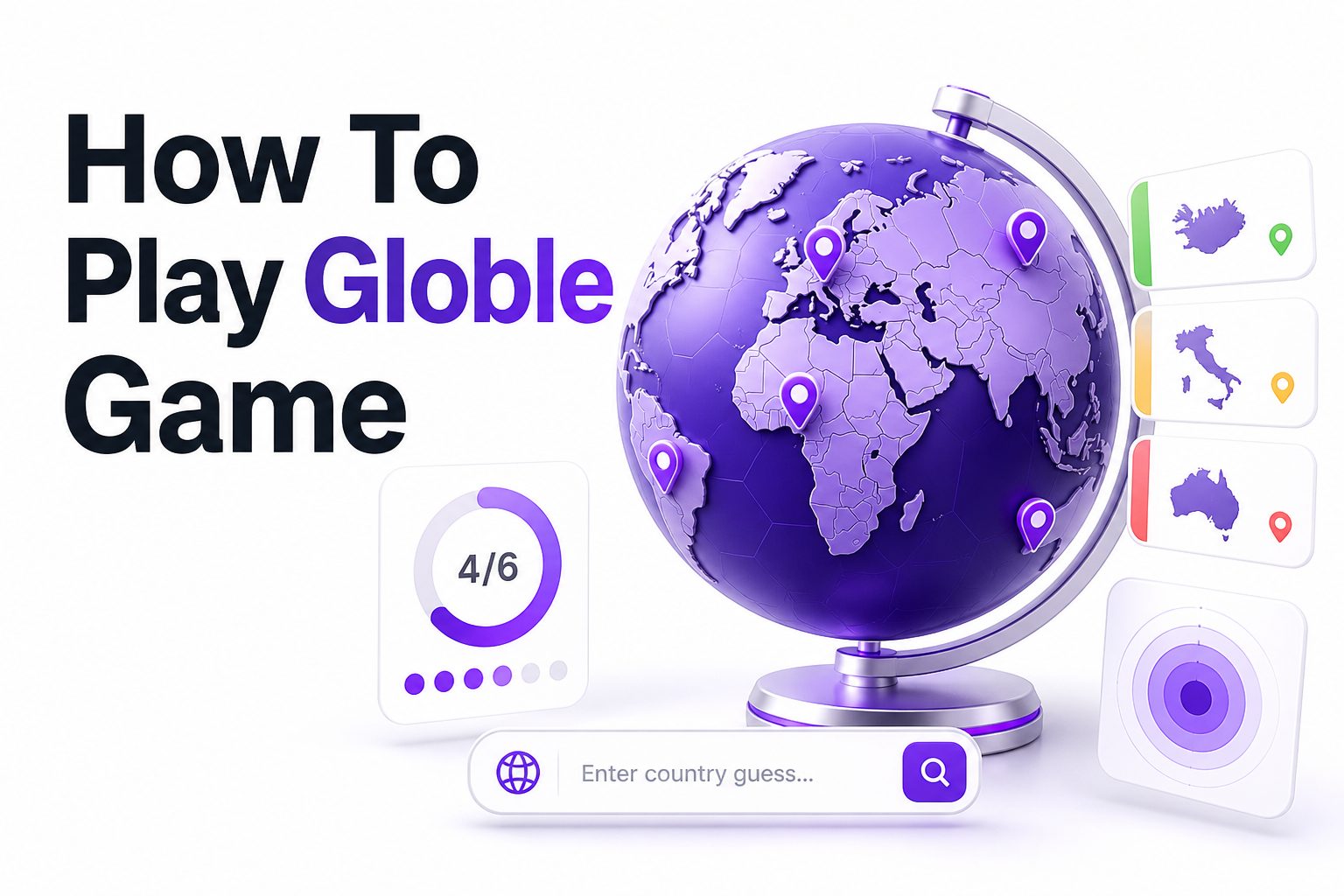
Globle looks simple at first: guess a mystery country, use the color feedback, and keep narrowing the map until you find the answer. The challenge is that it tests both geography knowledge and logical thinking, not just memory. If you have ever stared at a nearly red country and still felt lost, you are not alone.
Learning how to play globle game is mostly about reading distance clues correctly. Each guess tells you how close you are to the hidden country, and every shade on the map helps you adjust your next move. Once you know how to start, how to interpret colors, and how to avoid wasted guesses, the game becomes much more satisfying. This guide explains the rules, practical strategies, common mistakes, and smart guessing habits that can help you solve the daily Globle puzzle with confidence.
What the Globle Game Is
Globle is a daily geography guessing game where the goal is to identify one mystery country. You type the name of a country, and the game colors it based on how close it is to the correct answer. The warmer the color, the closer your guess is.
Unlike traditional trivia games, Globle does not ask direct questions or offer multiple-choice answers. It gives you spatial feedback instead. That makes it useful for learning world geography because every guess pushes you to think about borders, regions, oceans, and relative distance.
Basic Rules of Globle
The main rule is simple: guess the hidden country using as few attempts as possible. After each country you enter, Globle shows a color clue. Pale colors mean your guess is far away, while deeper orange or red means you are getting close.
There is no strict guess limit in the standard version, so beginners can take their time. However, many players like to challenge themselves by solving it in fewer guesses. The game resets daily, giving everyone the same country to find.
Quick Globle Rule Checklist
- Guess one valid country at a time.
- Use the color shade to judge distance.
- Darker and warmer colors mean closer.
- Cooler or lighter colors mean farther away.
- Keep moving geographically based on feedback.
- The final answer is always a country.
- Daily puzzles reset with a new mystery country.
How the Color Clues Work
Color is the most important feedback in Globle. A very light shade usually means your guess is far from the mystery country. A darker orange or red shade tells you that your guess is much closer and should guide your next guesses nearby.
The clue is based on distance, not shared borders. A country can be very close across a narrow sea even if it does not touch the answer. This matters in places such as the Mediterranean, Caribbean, Southeast Asia, and the Persian Gulf.
Why Distance Matters More Than Direction
Globle does not directly tell you whether to move north, south, east, or west. It only tells you how close your guess is. You must compare several guesses to work out direction and region, which is where strategy becomes important.
For example, if Turkey is warmer than Germany and Egypt is warmer than Turkey, you may need to look toward the eastern Mediterranean, North Africa, or the Middle East. Comparing guesses helps you build a mental map instead of relying on one clue.
Best Starting Countries
A good starting guess should help you locate the broad region quickly. Many players begin with large, central, or well-spaced countries such as Brazil, India, France, Egypt, or Indonesia. These guesses cover different parts of the world and give useful distance signals.
Avoid starting with tiny island nations unless you have a specific strategy. Small or remote countries can be correct answers, but they are less useful as opening guesses because they may not help you compare large geographic zones efficiently.
Smart Opening Guess Examples
- France for Western Europe and nearby North Africa.
- Egypt for Africa, the Middle East, and the Mediterranean.
- India for South Asia and nearby regions.
- Brazil for South America and the Atlantic side.
- Indonesia for Southeast Asia and Oceania.
- Mexico for North America, Central America, and the Caribbean.
How to Build a Strong Guessing Strategy
The best strategy is to think in regions first, then countries. Your opening guess should tell you whether the answer is in the same part of the world or far away. From there, choose a second country in a different direction to compare distance.
If your first guess is cold, do not panic. A cold answer still removes a huge area from consideration. The real value comes from comparing two or three guesses and noticing which one gets warmer. That pattern points you toward the right region.
Using Regional Clusters
Once you get a warm country, stop jumping across the globe. Focus on nearby countries, neighboring regions, and countries across short bodies of water. This is where many players waste guesses by moving too far away after receiving helpful feedback.
For example, if Greece is warm, test Turkey, Albania, Bulgaria, or nearby Mediterranean countries. If Colombia is warm, consider Venezuela, Ecuador, Panama, and nearby Caribbean nations. Regional clustering helps you turn a broad clue into a tight search area.
Common Mistakes Beginners Make
One common mistake is guessing countries randomly after seeing a warm color. Globle rewards direction and comparison. If a guess is warmer, your next move should be geographically related, not based on a country name that simply comes to mind.
Another mistake is assuming borders are everything. Distance can cross water, and some countries are closer than they look on flat maps. A country across a narrow strait may be a better guess than a land neighbor located much farther from the target.
Beginner Mistake Versus Better Move
Mistake | Better Move
Randomly guessing after each clue | Compare nearby countries logically
Ignoring islands | Check nearby seas and island groups
Only thinking about borders | Think about actual distance
Starting with obscure countries | Use broad regional openers
Moving too far after warm feedback | Stay close and narrow the area
How to Read Warm and Cold Guesses
A cold guess is not a failure. It gives you a boundary. If Canada is very cold and Egypt is warmer, you know the answer is likely much closer to Africa, Europe, or Asia than to North America. That contrast is useful.
A warm guess should change your behavior. Instead of testing another continent, check the surrounding region. If the color gets hotter, continue in that direction. If it cools down, move back toward your previous warm country and test a different neighbor.
Using Continents to Narrow the Answer
Continents are a helpful starting framework, but they are not perfect. Europe and Asia connect across a large landmass, and Africa sits close to Europe and the Middle East. Island countries can also confuse players who think only in continental blocks.
Still, continent-level thinking helps early in the game. If several guesses in Europe are warmer than guesses in the Americas or East Asia, your search should stay around Europe, North Africa, or western Asia until the colors prove otherwise.
Practical Tips for Faster Solves
Use countries you can place accurately on a map. A clever guess is only useful if you know where it is. If you guess a country but cannot picture its location, the color clue will be harder to use and may lead you astray.
It also helps to learn common regional neighbors. Knowing that Laos borders Thailand, that Slovenia is near Italy and Croatia, or that Benin sits beside Togo and Nigeria can save several guesses during a close search.
Useful Globle Solving Tips
- Start with a country you know well.
- Compare at least two regions early.
- Follow warmer colors carefully.
- Use neighboring countries once close.
- Remember islands and narrow seas.
- Avoid guessing countries you cannot place.
- Keep a mental list of colder regions.
How to Handle Island Countries
Island countries can make Globle tricky because they may not be near many visible land borders. The Caribbean, Pacific, Indian Ocean, and Southeast Asia all contain countries that are easy to overlook during a continental search.
When your guesses become warm near a coastline, consider nearby islands. For example, if Venezuela or Colombia is warm, check Caribbean nations. If Mozambique or Tanzania is warm, island countries in the Indian Ocean may be worth considering.
Small Countries and Hidden Challenges
Small countries often create frustration because they can be surrounded by larger, more familiar neighbors. Places like Andorra, Luxembourg, Eswatini, or Brunei may be close to obvious guesses but still easy to miss if you focus only on large nations.
The best approach is to slow down when the color turns very hot. Look carefully at the region and think of smaller countries nearby. If you are using a map for learning, zoom in mentally on compact regions with many borders.
Countries That Often Confuse Players
- Caribbean island nations near Central and South America.
- Balkan countries in southeastern Europe.
- Small European states near France, Spain, Italy, and Germany.
- West African countries with narrow borders.
- Gulf countries near Saudi Arabia and Iran.
- Pacific island nations spread across large ocean areas.
How Globle Helps You Learn Geography
Globle improves geography because it makes location knowledge practical. Instead of memorizing a list of capitals or flags, you actively use country positions. The feedback teaches distance, regional grouping, and spatial relationships in a way that feels natural.
Over time, you begin to remember countries because you used them in context. You may learn where Moldova is because Romania was hot, or remember Lesotho because South Africa was extremely close. That active recall is stronger than passive reading.
Playing Globle Without Looking Up Answers
It is tempting to search for the daily answer, but doing so removes most of the learning value. A better option is to use an atlas or world map only after you have made several honest guesses and need geographic support.
Using a map is not cheating if your goal is learning. It can help you connect color feedback with real locations. For players who want a stricter challenge, solve without outside tools first, then review the map afterward.
Learning Benefits of Regular Play
- Builds stronger mental maps.
- Improves recognition of country locations.
- Teaches regional relationships naturally.
- Helps with continents, borders, and seas.
- Makes geography practice more enjoyable.
- Encourages logical thinking and deduction.
- Supports daily learning in short sessions.
Advanced Strategy for Lower Guess Counts
Advanced players usually start with a planned spread of guesses. They may test one country in Europe, one in Asia, one in Africa, and one in the Americas. This creates a distance pattern that quickly points toward the likely region.
Once they find the warmest area, they make precise neighboring guesses. The goal is not to name every nearby country randomly, but to triangulate the answer. Each guess should either confirm a direction or rule out a nearby possibility.
Triangulation in Simple Terms
Triangulation means using several distance clues together. If Morocco is warm, Spain is warmer, and Italy is cooler, the answer may be near the western Mediterranean. You are not following one clue; you are comparing multiple clues to locate the target.
This method works especially well when countries are close together. In Europe, Central America, and parts of Africa, many countries sit near one another. Small differences in color can reveal whether you should move east, west, inland, or toward the coast.
How to Avoid Guess Fatigue
Guess fatigue happens when you make too many attempts without a clear plan. The puzzle begins to feel random, and you may stop using the feedback carefully. When that happens, pause and review your warmest and coldest countries.
Write down or mentally rank your guesses from hottest to coldest. The answer is usually near the hottest cluster and away from repeated cold areas. This simple reset can turn a messy round into a manageable puzzle again.
A Simple Recovery Method
- Identify your warmest guess.
- List the countries directly around it.
- Check nearby islands or coastal countries.
- Compare one country in each direction.
- Stop guessing faraway places.
- Use the coldest guesses as eliminated zones.
- Return to the map pattern, not memory alone.
Globle Compared With Similar Word Games
Globle became popular partly because it borrows the daily puzzle habit from word games, but it uses geography instead of letters. Each day offers a single shared answer, which makes it easy to compare results with friends or online communities.
Unlike Wordle-style games, Globle does not give position-based clues. There are no green letters or fixed boxes. The puzzle is more open-ended, so success depends on how well you interpret distance and organize geographic possibilities.
Why Geography Fans Enjoy It
Geography fans like Globle because it rewards real-world knowledge without feeling like a school quiz. You can solve through reasoning even if you do not know every country perfectly. The game welcomes both casual players and serious map enthusiasts.
It also creates small learning moments. Missing a country often leads you to remember it later. A tough puzzle involving the Balkans, Central Asia, or the Caribbean can permanently improve your awareness of that region.
Comparison With Other Daily Puzzle Types
Game Type | Main Skill | Feedback Style
Globle | Country location | Distance and color
Word puzzle | Vocabulary | Letter placement
Map quiz | Memorization | Correct or incorrect
Trivia game | General knowledge | Direct answers
Flag game | Visual recognition | Image matching
Playing Globle on Mobile and Desktop
Globle works well on both mobile and desktop browsers. On desktop, the larger screen makes it easier to view the map and compare country locations. This can be helpful when the answer is in a region with many small countries.
Mobile play is convenient for quick daily attempts, but small countries can be harder to tap or identify visually. If you are stuck on a compact region, switching to a larger screen may help you notice countries you missed.
Keeping Notes Without Overcomplicating
You do not need a spreadsheet to play well, but simple notes can help. Track your warmest guesses and the direction you moved afterward. This is especially useful when solving difficult puzzles involving islands, enclaves, or unfamiliar regions.
For related geography practice, see our [Internal Link: country guessing games] resource. It can help you build the regional awareness that makes Globle easier, especially if you want to improve without memorizing long country lists.
Daily Practice Routine for Better Results
A good routine starts with one broad opening guess, followed by a second guess in a different major region. By the third or fourth attempt, you should have enough information to choose a continent or nearby regional zone.
After solving, spend one minute reviewing the country’s neighbors. This habit matters more than the score. Daily review turns a simple puzzle into steady geography practice, and your future guesses become faster because the same regional patterns appear again.
How to Play With Friends
Globle is more fun when you compare results, but avoid spoiling the answer too early. Share the number of guesses, your first country, or your warmest clue instead. That keeps the puzzle fair for anyone who has not played yet.
You can also create friendly challenges, such as solving without a map or limiting yourself to ten guesses. These small rules add variety and help players practice different skills. For more ideas, visit [Internal Link: geography game strategies].
Friendly Challenge Ideas
- Solve in ten guesses or fewer.
- Use no outside map until guess five.
- Start with a different continent each day.
- Share only your first guess with friends.
- Review one new region after every puzzle.
- Try solving aloud to explain your reasoning.
Conclusion
Globle is simple enough to start in minutes, but it becomes more rewarding when you treat each guess as useful information. The color system teaches you to compare distances, identify regions, and think carefully about countries near borders, seas, and islands. Good players do not just know more countries; they make better use of every clue.
If you are new, begin with familiar countries, compare broad regions, and move toward warmer colors with patience. As you improve, practice triangulation, learn smaller nations, and review difficult regions after each round. That steady habit will help you solve puzzles faster and remember more geography along the way. Once you know how to play globle game, each daily puzzle becomes a short, satisfying test of logic, memory, and world knowledge.
FAQ
Is Globle free to play?
Yes, Globle is free to play in a web browser. Most players use it as a daily puzzle, and the standard version gives one mystery country each day for everyone to solve.
What does red mean in Globle?
Red means your guessed country is very close to the hidden country. The deeper and warmer the shade, the nearer you are. Use that clue to test neighboring countries or nearby islands.
Can the Globle answer be an island country?
Yes, the mystery country can be an island nation. If your warmest guesses are near a coast or island region, consider places in the Caribbean, Pacific, Mediterranean, or Indian Ocean.
What is a good first guess in Globle?
A good first guess is a country you can place easily, such as France, Egypt, India, Brazil, or Indonesia. Strong openers help you compare regions and narrow the search quickly.
How can I get better at Globle?
Play regularly, review the answer’s location, and learn nearby countries after each puzzle. Focus on comparing warm and cold guesses instead of guessing randomly, and your results will improve over time.
0 Comments